Daily LEGO Techniques, MOCs, and more!

#2935 DISCUSSION: Bricks for the Blind – Part 2

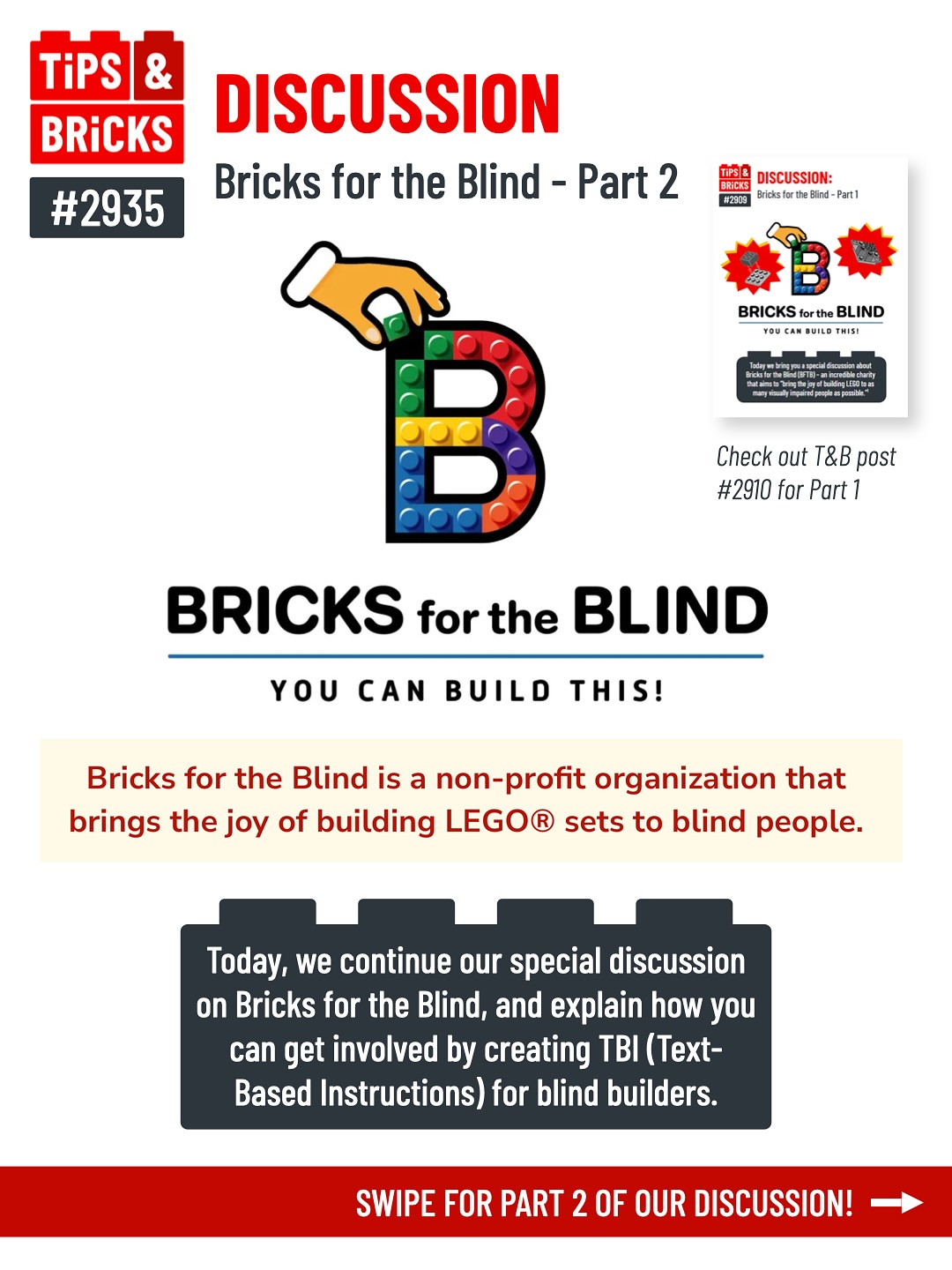
Today, we continue our special discussion on Bricks for the Blind, and explain how you can get involved by creating TBI (Text-Based Instructions) for blind builders:
#2935 DISCUSSION: Bricks for the Blind - Part 2
Image of Bricks for the Blind - Part 1.
Check out T&B post #2910 for Part 1.
Image of BFTB logo and slogan, “you can build this!“
Bricks for the Blind is a non-profit organization that brings the joy of building LEGO sets to blind people. 
Today, we continue our special discussion on Bricks for the Blind, and explain how you can get involved by creating TBI (Text-Based Instructions) for blind builders.
SWIPE FOR PART 2 OF OUR DISCUSSION!
Get Started
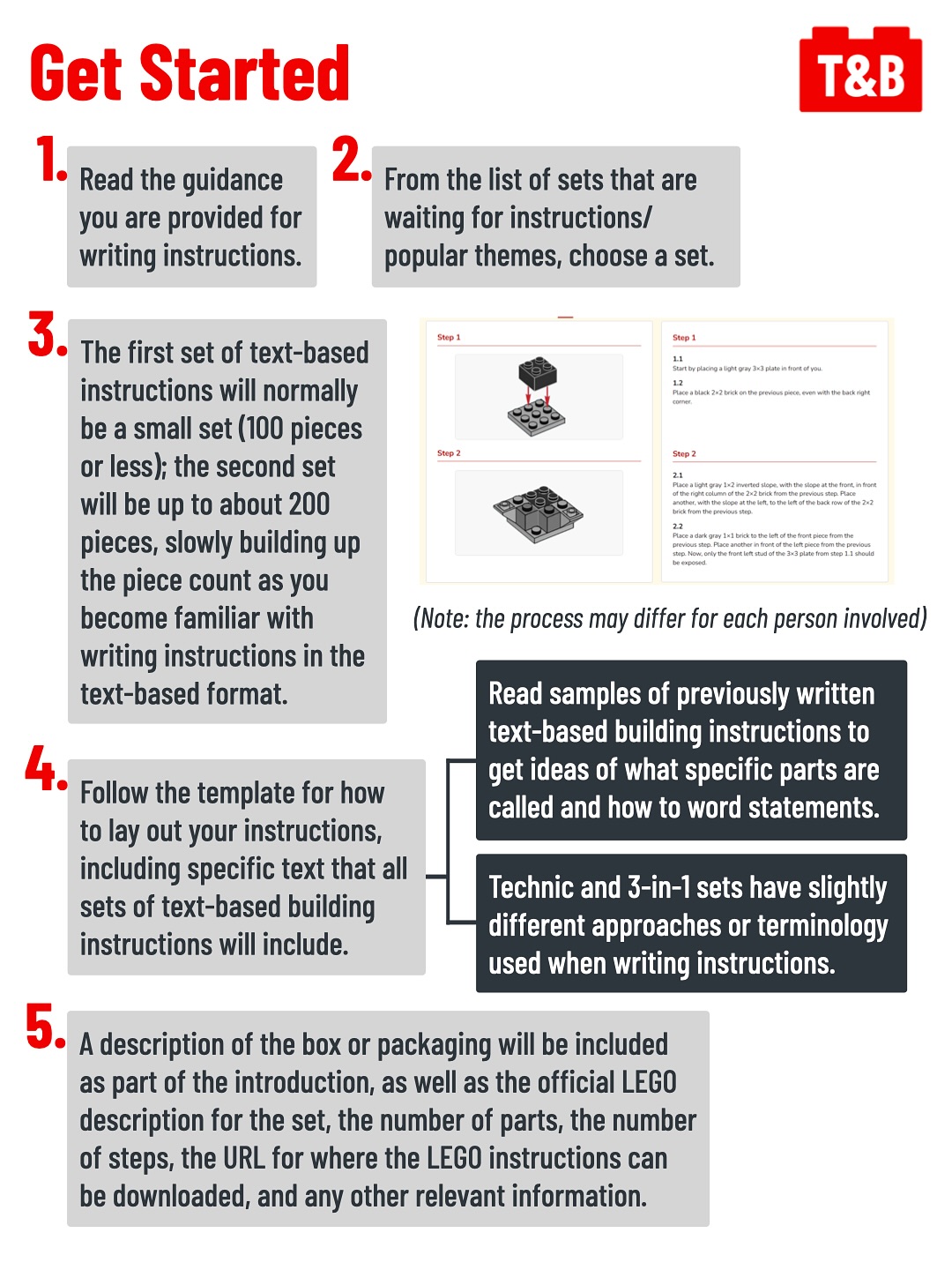
1. Read the guidance you are provided for writing instructions.
2. From the list of sets that are waiting for instructions/popular themes, choose a set.  
3. The first set of text-based instructions will normally be a small set (100 pieces or less); the second set will be up to about 200 pieces, slowly building up the piece count as you become familiar with writing instructions in the text-based format.  
4. Follow the template for how to lay out your instructions, including specific text that all sets of text-based building instructions will include. 
Read samples of previously written text-based building instructions to get ideas of what specific parts are called and how to word statements.  
Technic and 3-in-1 sets have slightly different approaches or terminology used when writing instructions.  
5. A description of the box or packaging will be included as part of the introduction, as well as the official LEGO description for the set, the number of parts, the number of steps, the URL for where the LEGO instructions can be downloaded, and any other relevant information.
Image of a sample BFTB TBI with the caption, “Note: the process may differ for each person involved.”
Sort & Orient
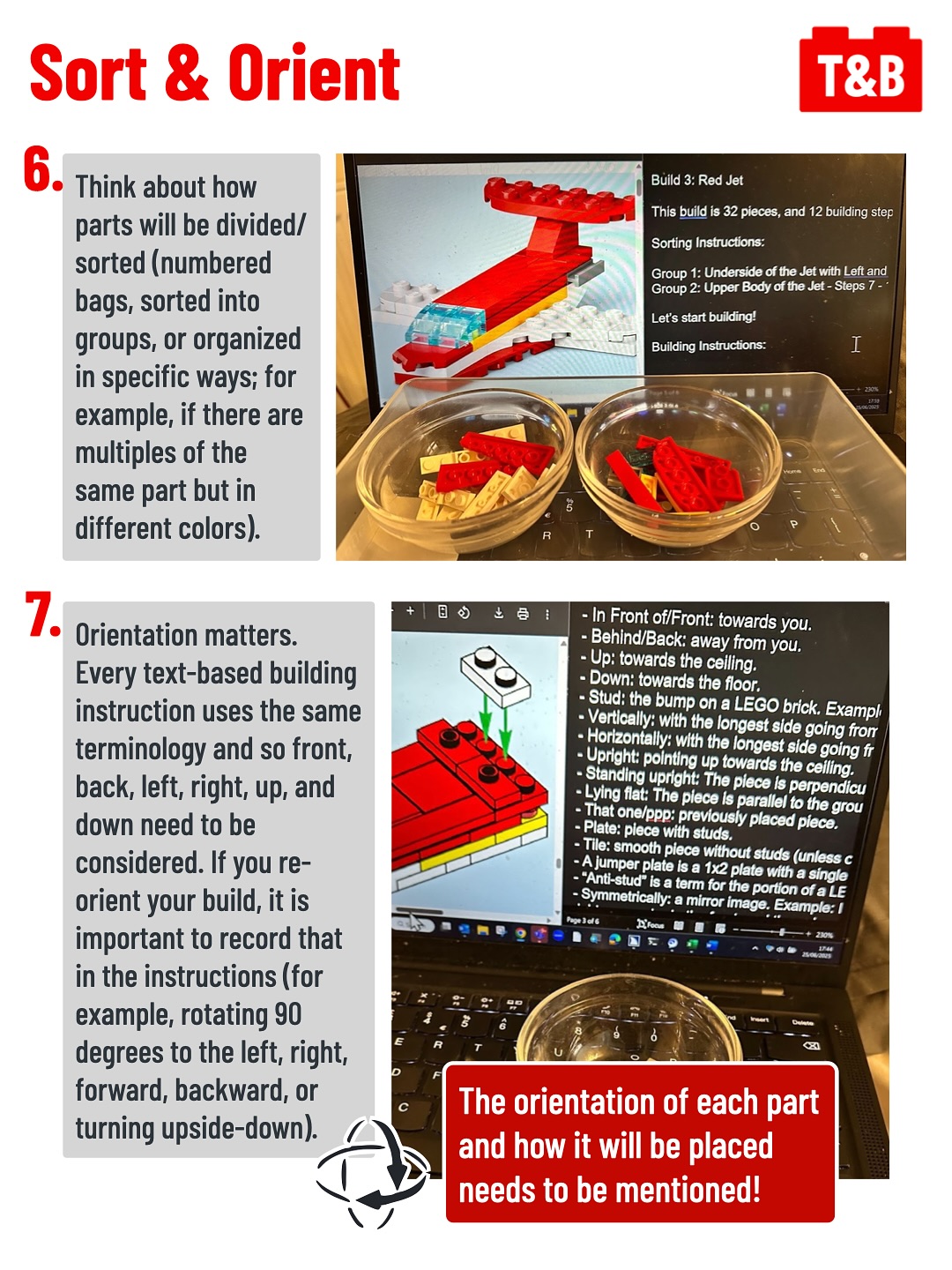
6. Think about how parts will be divided/sorted (numbered bags, sorted into groups, or organized in specific ways; for example, if there are multiples of the same part but in different colors).
Image of sorted LEGO pieces in bowls next to a screen showing TBI being written.
7. Orientation matters. Every text-based building instruction uses the same terminology and so front, back, left, right, up, and down need to be considered. If you re-orient your build, it is important to record that in the instructions (for example, rotating 90 degrees to the left, right, forward, backward, or turning upside-down).

The orientation of each part and how it will be placed needs to be mentioned!
Image of a section of TBI being written describing the orientation and placement of LEGO pieces.
Adapt Visuals
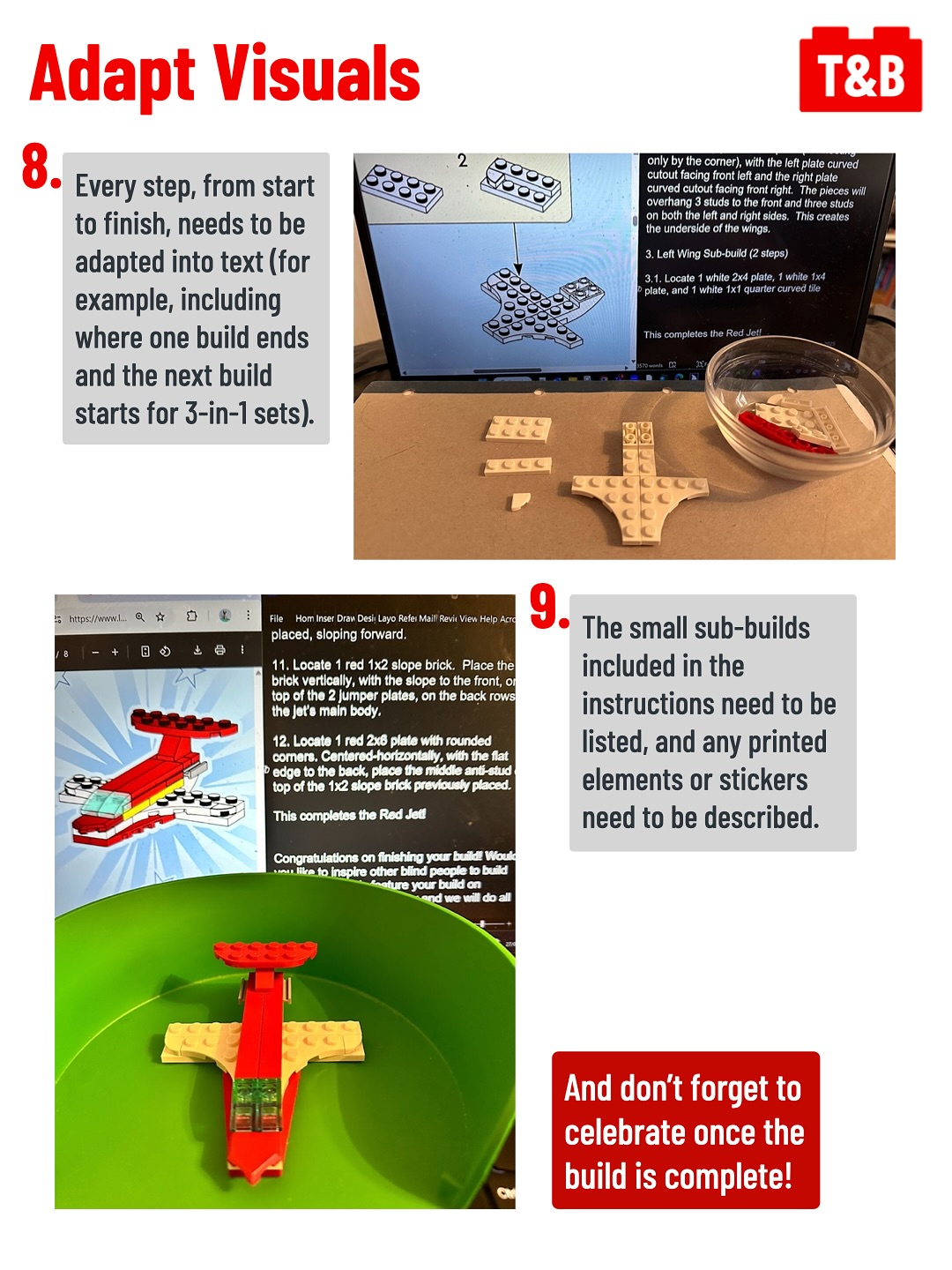
8. Every step, from start to finish, needs to be adapted into text (for example, including where one build ends and the next build starts for 3-in-1 sets).
Image of a partially constructed LEGO model next to a screen showing TBI being written.
9. The small sub-builds included in the instructions need to be listed, and any printed elements or stickers need to be described. 
Image of the fully constructed LEGO model, 30669 Iconic Red Plane, next to a screen showing the completed TBI.
And don’t forget to celebrate once the build is complete!
Test, Revise, Publish
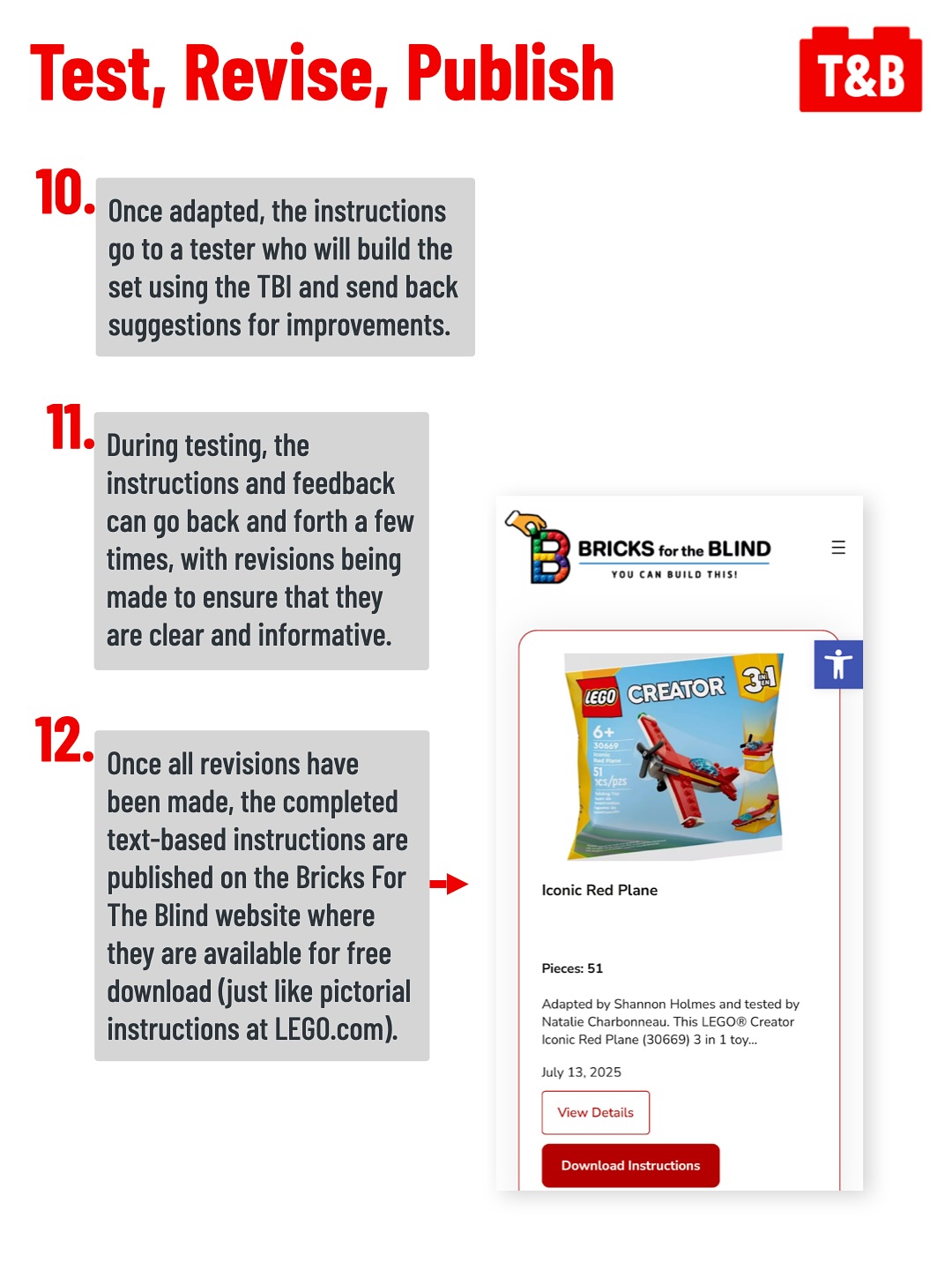
10. Once adapted, the instructions go to a tester who will build the set using the TBI and send back suggestions for improvements.
11. During testing, the instructions and feedback can go back and forth a few times, with revisions being made to ensure that they are clear and informative. 
12. Once all revisions have been made, the completed text-based instructions are published on the Bricks For The Blind website where they are available for free download (just like pictorial instructions at LEGO.com).
Image of the TBI for 30669 Iconic Red Plane on the BFTB website.

Contributor Voices
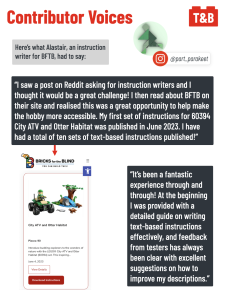
Here’s what Alastair, an instruction writer for BFTB, had to say:
Alastair’s Instagram profile, @part_parakeet with an image of their profile picture. 
“I saw a post on Reddit asking for instruction writers and I thought it would be a great challenge! I then read about BFTB on their site and realised this was a great opportunity to help make the hobby more accessible. My first set of instructions for 60394 City ATV and Otter Habitat was published in June 2023. I have had a total of ten sets of text-based instructions published!”
Image of the TBI for 60394 City ATV and Otter Habitat on the BFTB website.
“It’s been a fantastic experience through and through! At the beginning I was provided with a detailed guide on writing text-based instructions effectively, and feedback from testers has always been clear with excellent suggestions on how to improve my descriptions.”

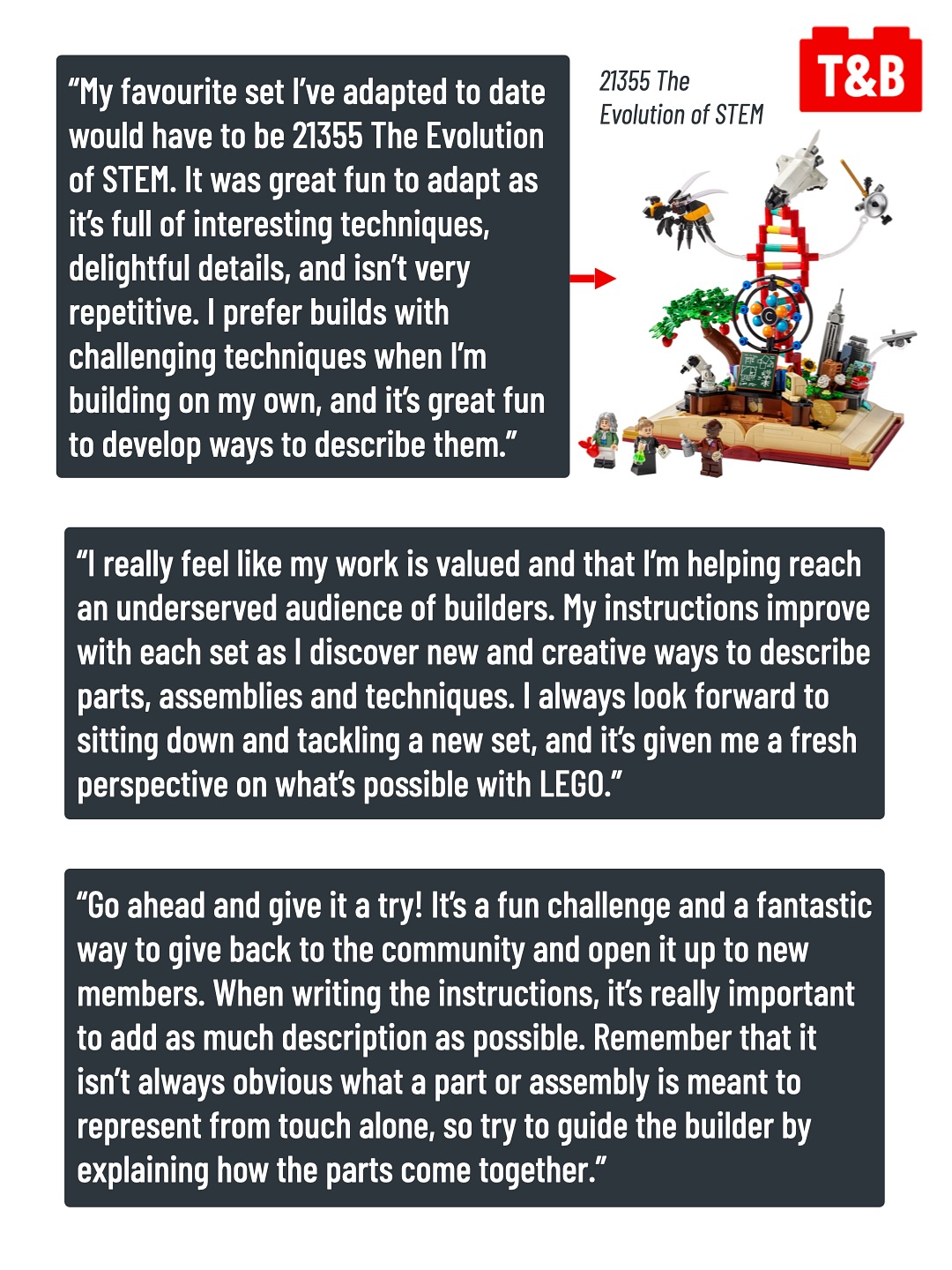
“My favourite set I’ve adapted to date would have to be 21355 The Evolution of STEM. It was great fun to adapt as it’s full of interesting techniques, delightful details, and isn’t very repetitive. I prefer builds with challenging techniques when I’m building on my own, and it’s great fun to develop ways to describe them.”
Image of 21355 The Evolution of STEM.
“I really feel like my work is valued and that I’m helping reach an underserved audience of builders. My instructions improve with each set as I discover new and creative ways to describe parts, assemblies and techniques. I always look forward to sitting down and tackling a new set, and it’s given me a fresh perspective on what’s possible with LEGO.”   
“Go ahead and give it a try! It’s a fun challenge and a fantastic way to give back to the community and open it up to new members. When writing the instructions, it’s really important to add as much description as possible. Remember that it isn’t always obvious what a part or assembly is meant to represent from touch alone, so try to guide the builder by explaining how the parts come together.”
Now let’s hear from Natalie, a TBI tester:
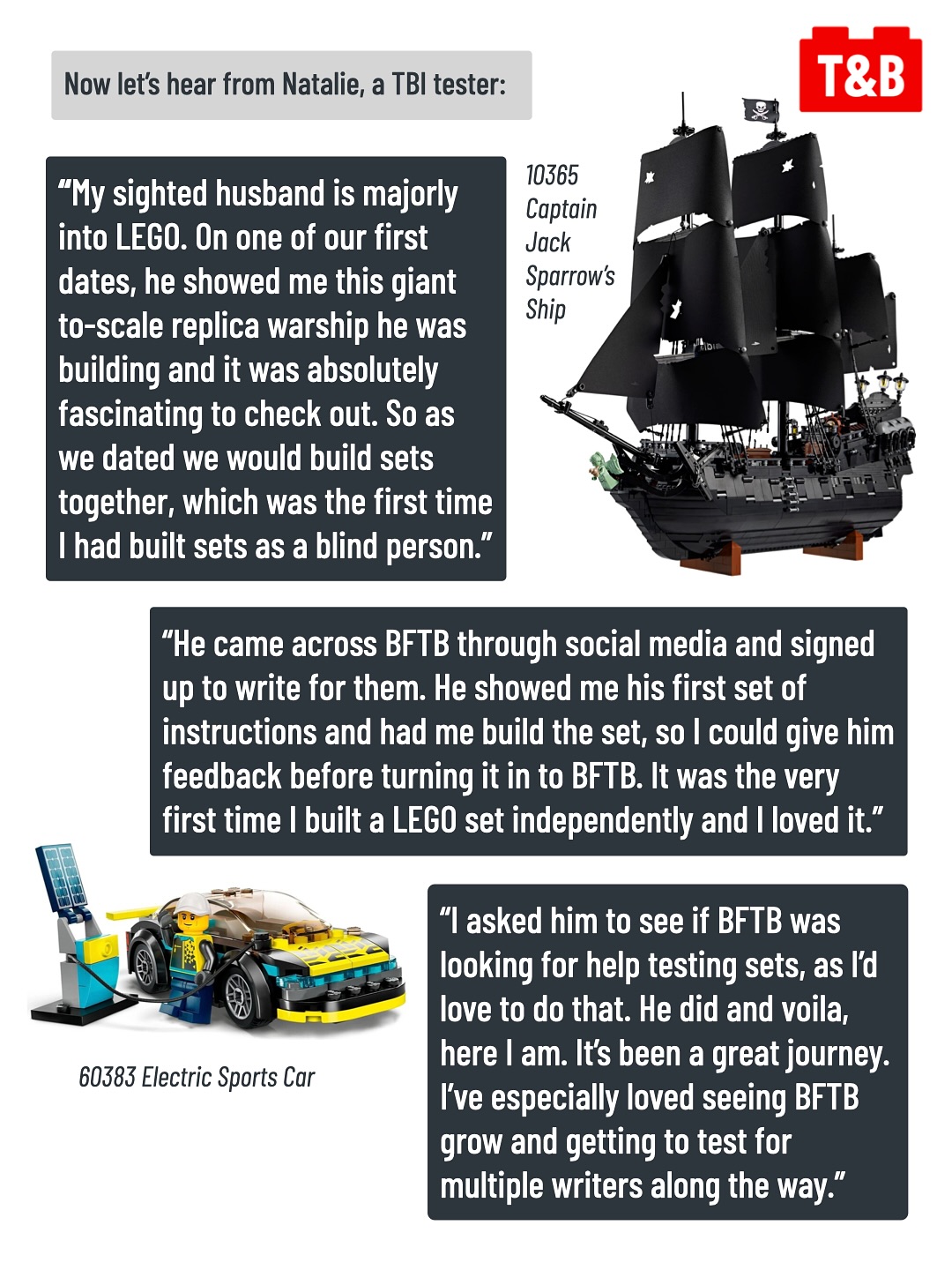
“My sighted husband is majorly into LEGO. On one of our first dates, he showed me this giant to-scale replica warship he was building and it was absolutely fascinating to check out. So as we dated we would build sets together, which was the first time I had built sets as a blind person.”
Image of 10365 Captain Jack Sparrow’s Ship.
“He came across BFTB through social media and signed up to write for them. He showed me his first set of instructions and had me build the set, so I could give him feedback before turning it in to BFTB. It was the very first time I built a LEGO set independently and I loved it.”
Image of 60383 Electric Sports Car
“I asked him to see if BFTB was looking for help testing sets, as I’d love to do that. He did and voila, here I am. It’s been a great journey. I’ve especially loved seeing BFTB grow and getting to test for multiple writers along the way.”
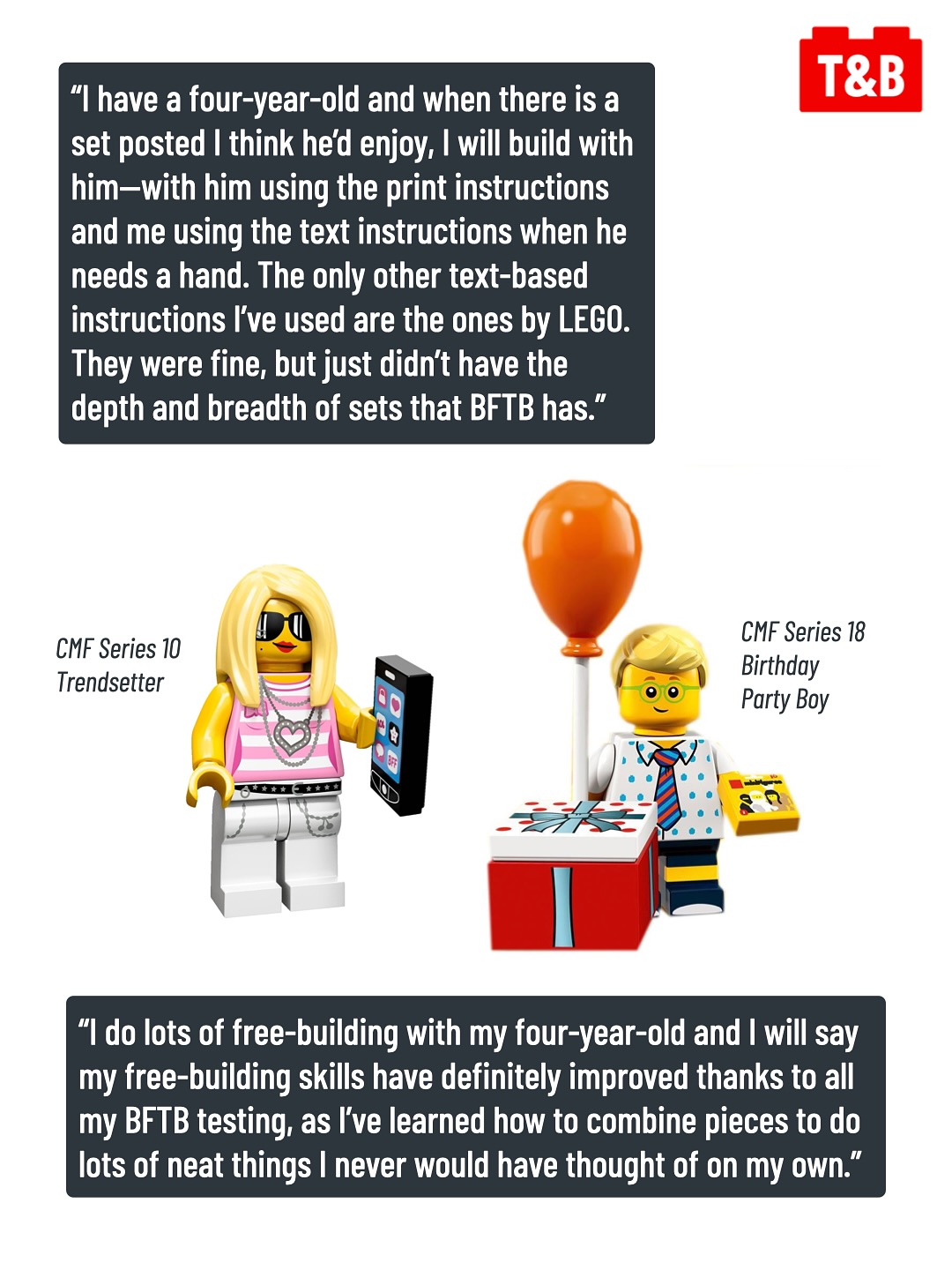
“I have a four-year-old and when there is a set posted I think he’d enjoy, I will build with him—with him using the print instructions and me using the text instructions when he needs a hand. The only other text-based instructions I’ve used are the ones by LEGO. They were fine, but just didn’t have the depth and breadth of sets that BFTB has.”
Image of CMF Series 10 Trendsetter and Series 18 Birthday Party Boy. 
“I do lots of free-building with my four-year-old and I will say my free-building skills have definitely improved thanks to all my BFTB testing, as I’ve learned how to combine pieces to do lots of neat things I never would have thought of on my own.”
While Natalie does not have one particular favourite set…
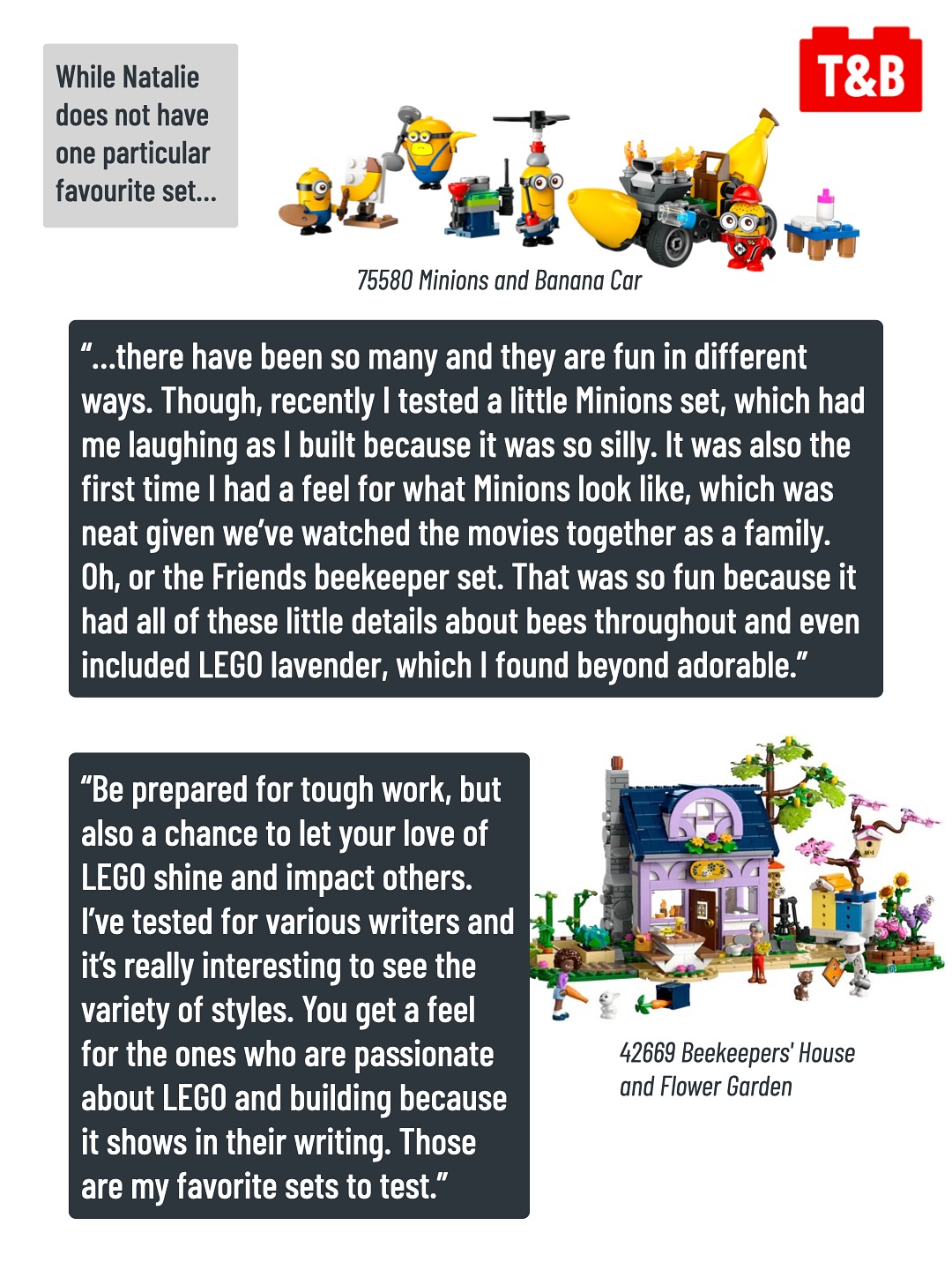
“…there have been so many and they are fun in different ways. Though, recently I tested a little Minions set, which had me laughing as I built because it was so silly. It was also the first time I had a feel for what Minions look like, which was neat given we’ve watched the movies together as a family. Oh, or the Friends beekeeper set. That was so fun because it had all of these little details about bees throughout and even included LEGO lavender, which I found beyond adorable.”
Images of 75580 Minions and Banana Car and 42669 Beekeepers' House and Flower Garden.
“Be prepared for tough work, but also a chance to let your love of LEGO shine and impact others. I’ve tested for various writers and it’s really interesting to see the variety of styles. You get a feel for the ones who are passionate about LEGO and building because it shows in their writing. Those are my favorite sets to test.”
Get Involved
Whether you could help to create instructions, share and raise awareness about BFTB on social media, donate, or create something amazing from the text-based instructions BFTB provides, there are lots of ways people can get involved and support this fabulous organization!
“Spread the word! Tell everyone you know about BFTB. Use social media to link to our website and channels. We want every blind person to know that they can build LEGO sets. We are always looking for sighted people to write instructions and blind people to test them. We provide monetary compensation for both testers and writers.”
Image of the BFTB logo and their Instagram profile, @bricks4theblind.
If you are interested in getting involved and becoming a BFTB writer or tester, email info@bricksfortheblind.org.
You will be sent a guide that explains the role you are interested in and the process of writing instructions (for sighted individuals) or set-testing (for blind builders).
Make a donation and help support the work that BFTB is doing: gofundme.com/f/bricks-for-the-blind-gofundme.

➡️ Getting Started

🧱 Sorting & Orienting

🖼️ Adapting Visuals

🔃 Testing, Revising, Publishing

Read on for more!

Similar Posts:

DISCUSSION: Black History Month 2026
DISCUSSION: LEGO Friends Characters and Colors
DISCUSSION: Languages in LEGO Products
DISCUSSION - Enjoying the Hobby and Staying Healthy with @bodybybrickz